
ABOUT JAIPUR CITY
One of the best planned cities of India, Jaipur is the capital city of the state of Rajasthan. Its features of beautiful Architecture, Town Planning, Arts and Crafts, Culture, tourism have endowed it with uniqueness in India’s urban character.
Jaipur being capital of Rajasthan and one of the important cities of Golden Triangle is the focus of the socio-economic and political center of the State. Jaipur is an expression of the astronomical skills, living traditions, unique urban form and exemplary foresighted city planning of an 18th century city from India.
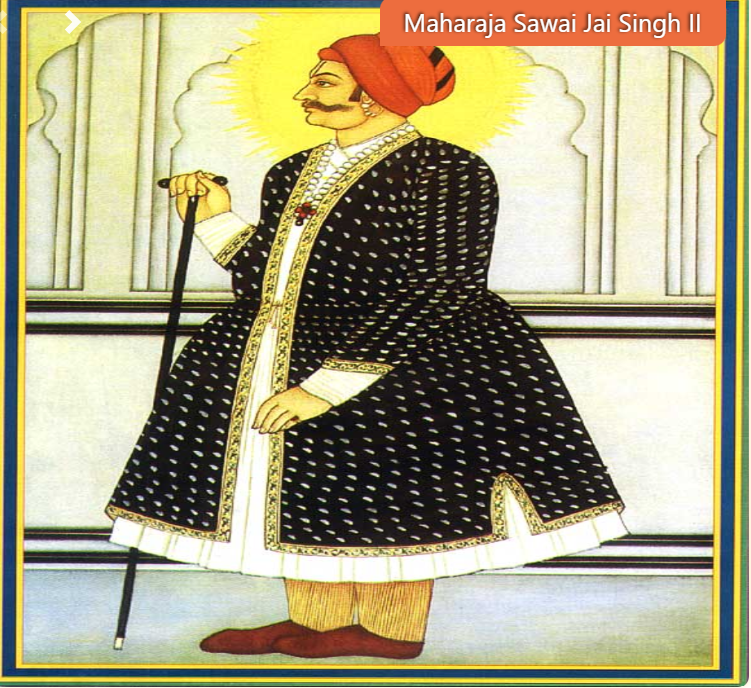
Amber was the capital of Kachwaha until 1727 when the ruler of Amber, Maharaja Sawai Jai Singh II founded a capital Jainagara (Jaipur) named after him, about nine kilometers South of Amber.
The Walled City of Jaipur is an exceptional urban example, was conceived and developed in a single phase in the 18th century with a grid-iron model inspired from the Prastara plan of the Vastu Shastra. Built under the patronage of Maharaja Sawai Jai Singh II who was scholar of Astronomy,
Jyotish and Vastu Shastra with the help of the then Town Planner Shri Vidhyadhar Bhattacharya, from 1727-1731 CE, within a span of four years, along with special royal invitations to several traders and craftsmen, inviting them to settle in this newly envisaged trade and commerce city.
Envisaged as a trade capital, the main avenues of the city were designed as markets, which remain significant bazaars of the city till date. Chaupar or designed large public squares at the intersection of roads, is another feature that is distinct to Jaipur as are its single to multicourt havelis and haveli temples.
The planned nine square (Chowkri) plan of Jaipur city was a grid defined by the main streets running north south and east-west. A massive city wall and nine gates were constructed around the walled city of Jaipur.
The Walled City of Jaipur was initially designed for a population of 60,000 inhabitants in an area of 6.74 sq. km and today it accommodates around 6 lac population. The walled city can still cater to the present-day pressures of vehicular traffic on roads.
ATTRACTIONS & PLACES TO VISIT AND EXPLORE IN JAIPUR
- Come explore the wonders and sites that Jaipur has to offer. There’s always something to see in Rajasthan.
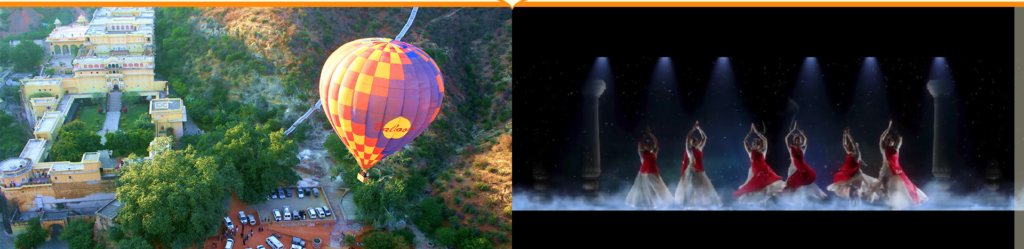
Light & Sound Show at Jainiwas Udhyan
Light & Sound Show at Jainiwas Udhyan is one of the first 3-D projection mapping-based light & sound show in Rajasthan using 3-chip DLP projectors of 25,000 lumens, DMX controlled LED lights, 5.1 audio surround system, etc.
Show depicts story of world-famous Shri Govind Dev Ji temple of Jaipur including carving of Shri Govind Dev Ji idol by Brijnabh (great grandson Shri Krishna), establishment of Shri Govind Dev Ji temple in Vrindavan,
hiding of idol due to attacks of invaders on temples, re-finding of idol by disciples of Shri Chetanaiya Mahaprabhu, bringing of Shri Govind Ji idol by King of Jaipur, establishment of Shri Govind Ji Temple in Jainiwas Udhyan (Jaipur).
Samode is a historic village in Rajasthan, India, located roughly 40 km north of Jaipur. Famous for its 16th-century Rajput heritage, the area is renowned for Samode Palace, Samode Haveli, and the tranquil Samode Bagh.
AMBER PALACE
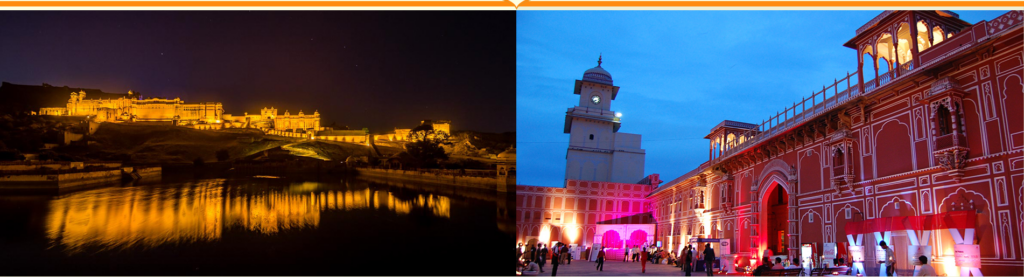
The palace, located in craggy hills, is a beautiful melange of Hindu and Mughal styles. Raja Man Singh I began construction in 1592 and the palace, which was built as a strong, safe haven against attacking enemies, was completed by Mirja Raja Jai Singh.
The palace is nearly seven centuries old and has a legendary past. Originally a small structure that the Rajputs won from the Meena tribes, it was later transformed into the grand Amber Palace.
CITY PALACE
Located deep within the walled city, the City Palace Complex was conceived and built by Maharaja Sawai Jai Singh II, the founder of Jaipur. A beautiful fusion of Mughal and Rajput architecture, the palace is still home to the last ruling royal family which lives in a private section of the palace
The Maharani’s Palace, surprisingly, has an interesting display of very well-preserved Rajput weaponry, some dating back to the 15th century. Other than the arms, the palace is adorned with beautiful paintings on the ceiling that are well-maintained.
jantar mantar
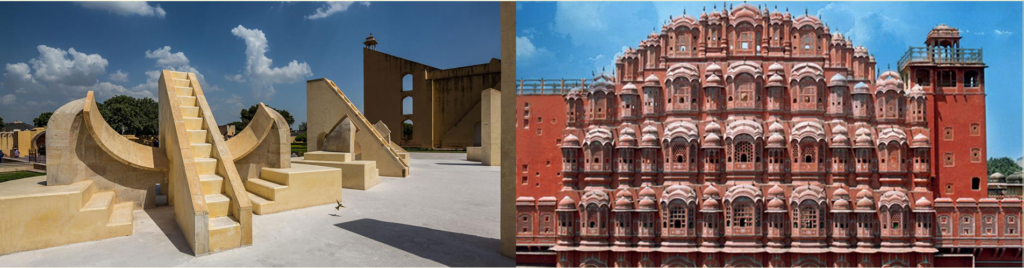
jantar Mantar comprises 18th-century stone astronomical observatories built by Maharaja Sawai Jai Singh II across North India to track celestial movements. The Jaipur site features 19 instruments, including the world’s largest stone sundial.
It also houses the Interpretation Centre that helps the tourists to understand about the working principles & chronolgy of the observatory.
HAWA MAHAL,
Hawa Mahal, or the “Palace of Winds,” is a five-story pink and red sandstone palace in Jaipur, India. Built in 1799 by Maharaja Sawai Pratap Singh and designed by architect Lal Chand Ustad, the structure features a unique honeycomb facade shaped like the crown of Lord Krishna.
Built from pink sandstone, the Hawa Mahal is Jaipur’s iconic landmark and visitors can view its complete magnificence from outside, from across the road.
ALBERT HALL MUSEUM (CENTRAL MUSEUM)
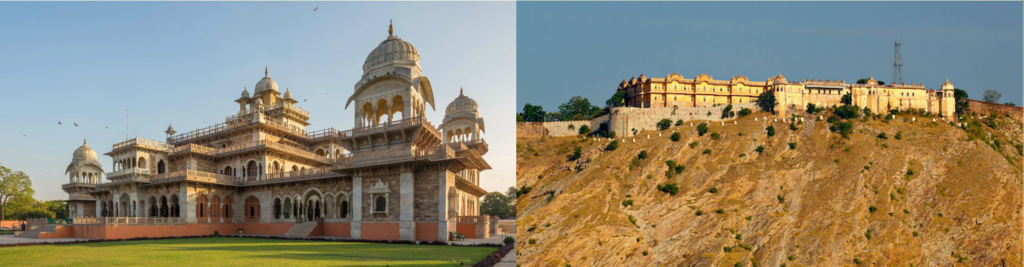
The museum displays a wide range of metal objects, wood crafts, carpets, stone and metal sculptures, arms and weapons, natural stones and ivory goods. It also houses a large collection of miniatures from Bundi, Kota, Kishangarh, Udaipur and Jaipur schools of art.
NAHARGARH FORT
Within its walls, the fort houses Madhavendra Bhawan, the summer destination for the members of the royal family. Built by Sawai Madho Singh, the palace has 12 matching boudoirs for the queens, at the head of which is a suite for the king.
JAIGARH FORT
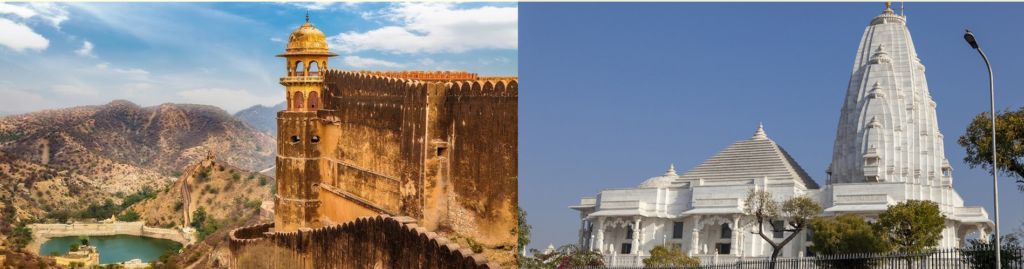
Today, Jaigarh Fort is a proud relic of a bygone era, its towering ramparts and intricate architecture captivating the hearts and minds of all who venture within. If you seek to understand the glorious history of Rajasthan, a visit to this Rajput stronghold is a must.
BIRLA TEMPLE
Birla Mandir is a Hindu temple located in Jaipur, India, and is one of many Birla mandirs. It was built by the B.M. Birla Foundation in 1988 and is constructed solely of white marble.
The eye is drawn to the images of Laxmi and Narayan, carved as they are, from one piece of marble. The top of the temple has three domes, each representing the three religions followed in India
